AIHubEnterprise AI & knowledge foundation
AIHub turns capabilities scattered across cloud models, agent platforms, business systems, documents and memory into shared enterprise intelligence. On the AI side it connects mainstream LLMs, industrial small models, external agents and business tools, orchestrated by a cognitive-agent runtime; on the knowledge side a Wiki structural hub plus RAG and memory organizes enterprise knowledge. Digital employees are built on both.
* Design targets; final figures depend on the released version and project evaluation.
Enterprises do not need another chat model; they need an AI and knowledge foundation
The real gap is that models, knowledge, business semantics and actions are still scattered across people, systems and channels.
- · Read SOPs and process documents
- · Log in to MES / ERP / CRM
- · Chase by phone, coordinate on WeChat, align by email
- · Answers questions
- · Forgets equipment history
- · Can't read the production structure or finish cross-system work
- · Carries enterprise structure and role memory
- · Organizes multi-step collaboration
- · Changes systems and reaches people within a whitelist, feeding evidence back
Two foundations: AI and knowledge
The AI foundation answers which capabilities to use and how to finish the work; the knowledge foundation answers which enterprise path to follow. Without knowledge, paths drift; without an AI runtime, a graph is just a static archive.
- · Models: mainstream LLMs plus industrial vision, acoustic and time-series small models
- · Capabilities: external agent platforms and business systems such as MES / ERP connected through MCP tools
- · Cognitive-agent runtime: orchestration, memory and execution, human review and re-planning
- · Open and governed: OpenKey + MCP + Skill, capability allowlists, tenant quotas and audit
- · Wiki structural hub: how the business is organized and which path to take now
- · RAG for details: L1 routing first, then drill into documents and the graph
- · Memory: situational memory of equipment, shifts and roles, with trust and correction
- · Compilation: execution evidence drives local compilation, merged after proposal approval
A digital employee = a role configured on both foundations
Not a model account, but a role unit with structured knowledge, memory and execution boundaries. To copy a role, swap the Wiki binding and tool whitelist — no need to rewrite its persona.
How a digital employee handles a line incident end to end
Every step happens in the same orchestration context, with memory loaded and a path already matched.
What changes is not the interface, but who organizes the work
People move from driving the process to approving key steps; digital employees carry memory and paths across systems.
| Work | Traditional | Digital employee |
|---|---|---|
| Line incident | Shift lead reads the SOP, then instructs the floor | Loads equipment and shift memory + Wiki hits the process path + orchestrated advice, writes to MES when needed |
| Anomaly diagnosis | Engineer checks history and judges manually | Memory surfaces past alarms + industrial small model + evidence fed back |
| Cross-system scheduling | Planner switches between ERP/MES/WMS | Task triggers topology + HITL approves key changes + full trace |
| Process Q&A | New hires ask veterans and read paper SOPs | Wiki L1 locates the process path + RAG drills down, read-only |
| Quality inspection | Visual check, manual logging, lead review | Vision model screens + branch review + re-inspect or auto-pass + evidence fed back |
| Multi-party coordination | Back-and-forth by phone, WeChat and email | System actions and channels dispatched together under one trace |
Wiki answers the path, RAG answers the details
Wiki is not a better knowledge base but the structural hub and runtime routing layer for enterprise knowledge. Every finished job makes the structure more stable.
- Structure graph
- The L2 property graph holds entities, relations and evidence, with health levels and drill-down navigation.
- Blueprint
- Blueprints define types, relations and predicate rules that govern how structure grows.
- Wiki pages
- Libraries compile into summary, entity and concept pages.
- Build queue
- Incremental compilation per source work item — never a full rewrite.
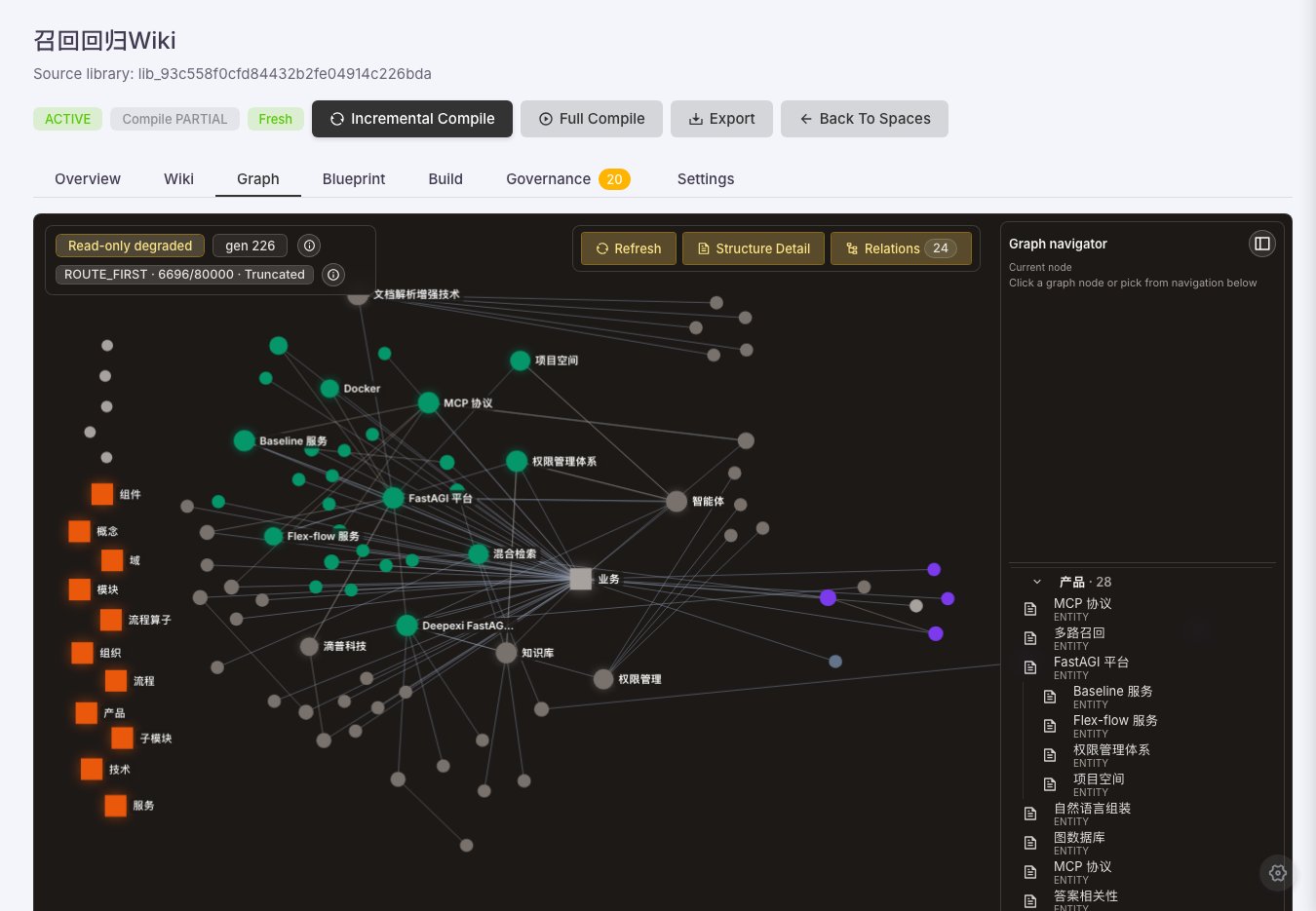
The L2 property graph holds entities, relations and evidence, with health levels and drill-down navigation.
| Traditional RAG | AIHub Wiki | |
|---|---|---|
| How it finds | Full-text/vector hits on fragments | An L1 decision map guides dispatch, then drills into L2 and documents |
| What you see | A handful of fragments | Decision paths, relations and structural health on the graph |
| How it improves | Load more documents | Execution evidence drives local compilation, merged after approval |
Real console screens
From role design and acceptance testing to runtime audit, every step has a visual workbench.
- Topology designer
- Steps, branches, human review, dispatch and execution become nodes.
- Agent hub
- One role unit per kind of work: categorize, create, enable and copy.
- Execution logs & trace
- Basis, decisions, tool calls and system changes are all traceable.
- Skill Club
- Role skill packages that can be installed, evaluated and signed.
- AI dashboard
- Check health after go-live before granting more permissions.
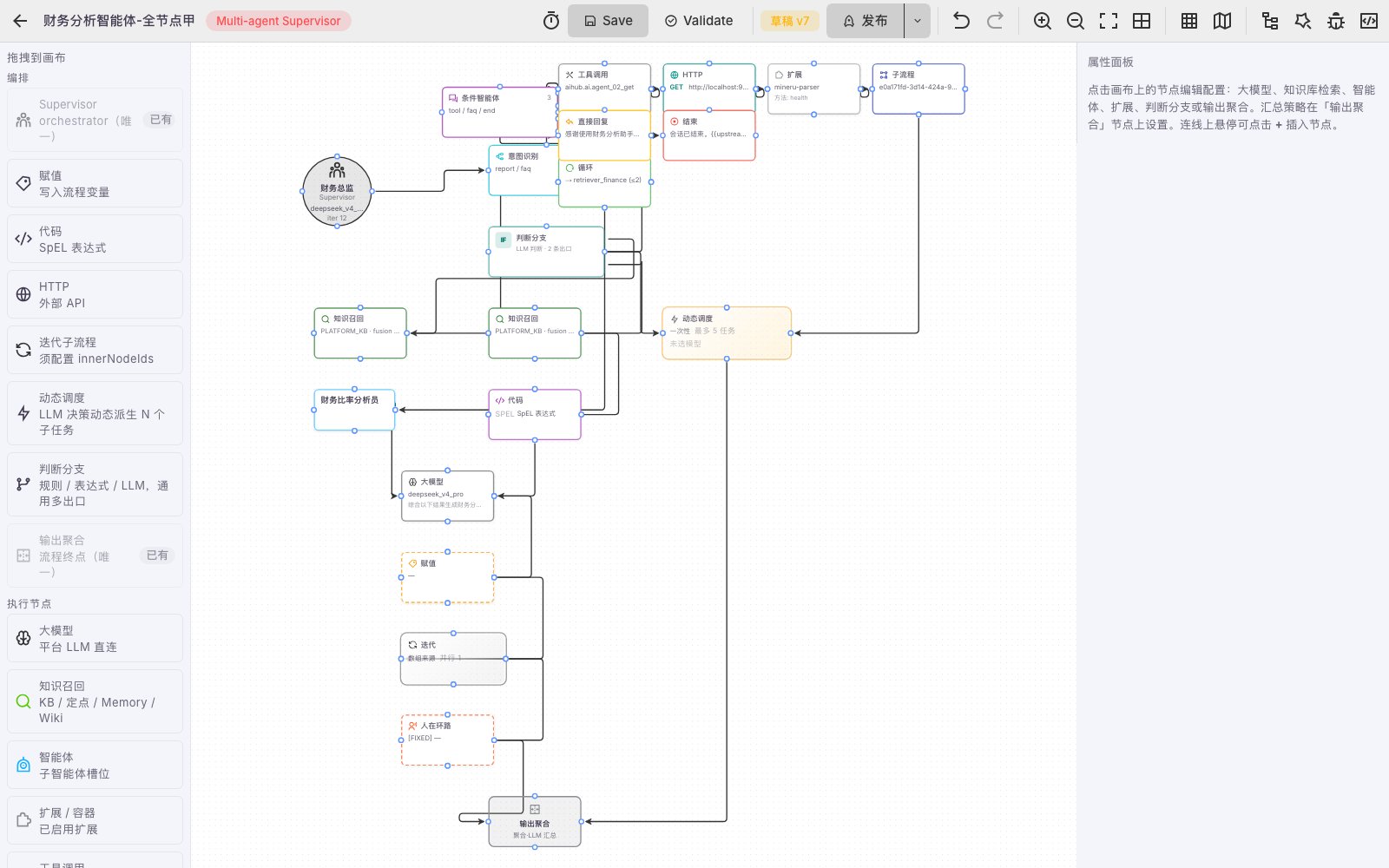
Steps, branches, human review, dispatch and execution become nodes.
Five capabilities that put employees to work
* Design targets; final figures depend on the released version and project evaluation.
The difference is not the model brand but whether AI works with enterprise knowledge
Successes enter the structure, failures become proposals: a foundation, not a chat wrapper.
| Dimension | Typical agent platform | AIHub enterprise AI & knowledge foundation |
|---|---|---|
| Unit of work | One chat / one prompt | A configurable, copyable digital employee per kind of work |
| Memory | Piled-up chat history | Five-layer memory tree with trust, toxicity and correction, in the execution context |
| Knowledge | Single vector RAG | Vectors + Wiki L1 routing + L2 graph, consumed by dispatch |
| Execution | A few built-in tools or plug-ins | Dispatches MES, small models, WeChat, phone and email |
| Models | One LLM | LLM orchestration + industrial vision, acoustic and time-series models |
| Orchestration | Linear agent or simple chain | Visual topology DAG + dynamic dispatch + sub-agents |
| Recovery | Retry or fail | Resume, replan, and turn failures into proposals |
| Flywheel | None | Evidence flows back to memory and Wiki; it gets steadier with use |
Four frontline scenarios
Structured knowledge is always at work; write access is granted by the role's tool whitelist.
In AUTOPLAT
AIDA is the private agent people use every day; AIHub supplies AI and knowledge; DataHub supplies governed data; AIBase trains models.
Build an AI and knowledge foundation for the enterprise
Book a demo and see models, knowledge and agents run on one foundation, with a kind of work configured as a digital employee.