DataHubAI-oriented data governance platform
Assets, standards, quality, security and open services run in one governed chain, and governance results are operated continuously. Governed results are then supplied to agents through knowledge and MCP / Skill contracts, so AI reads governed semantics instead of guessing fields; AI also takes part in discovery, governance, modeling and data development.
- Ingest
- Databases, files, CDC, streams and multimodal data flow into the lake through visual tasks.
- Store
- An Iceberg lakehouse plus an acceleration layer: one copy serves both detail storage and fast analytics.
- Govern
- Standards, models, metric definitions, quality checks and classified security become reusable assets.
- Serve
- Data services, open catalogs, subscriptions and event routes supply business systems securely.
- AI-consumable
- Knowledge outputs, training datasets and MCP/Skill interfaces let agents read governed data by contract.
* Lakehouse and development efficiency figures are typical-scenario estimates; actual results depend on project evaluation and deployment.
Data governance is turning toward AI
From storing data to using it, and from reports for people to consumption by systems and agents: governance is no longer a one-off project but the precondition for supplying AI.
One pipeline, five promises
Ingest → store → govern → serve → make it consumable by AI.
- Ingest
- Databases, files, CDC, streams and multimodal data flow into the lake through visual tasks.
- Store
- An Iceberg lakehouse plus an acceleration layer: one copy serves both detail storage and fast analytics.
- Govern
- Standards, models, metric definitions, quality checks and classified security become reusable assets.
- Serve
- Data services, open catalogs, subscriptions and event routes supply business systems securely.
- AI-consumable
- Knowledge outputs, training datasets and MCP/Skill interfaces let agents read governed data by contract.
AI takes part in governance and consumes its results
Not only is data used by AI; AI takes part in the data work itself.
MCP · Skill
Popular AI coding assistants and agents connect through MCP / Skill and read governed data contracts within their permissions.
- $ mcp call datahub.search_assets --q "receivables"
- → 3 governed assets · definition: finance domain v2
- $ mcp call datahub.describe fin_receivable
- → 18 fields · 12 standards · quality 96 · sensitivity L2
- $ mcp call datahub.query --metric overdue_amount --by customer
- → row-level permissions applied · 25 rows
Traditional build vs DataHub
| Area | Traditional | DataHub |
|---|---|---|
| Governance | Standards, models and metrics maintained separately | Model-native: modeling becomes assets, assets become knowledge |
| Supply | Point-to-point interfaces, separate permissions | Data services, subscriptions and unified approval |
| AI | Agents guess field meanings | Knowledge + MCP contracts; AI reads governed semantics |
| Storage | Two copies in lake and warehouse | Iceberg lakehouse: one copy, many workloads |
| Development | Scripts scattered across tools | Visual DAG + AI data development, stream and batch |
| Master data | Separate interfaces and reconciliation | Works with Maindata, sharing quality, lineage and open services |
Five advantages
Eight capability domains
Real console screens
From cockpit to pipelines, security and training data — one workbench for the whole chain.
- Processing workbench
- Organized as ingest → design → run and debug → governance checks → publish services.
- Cockpit
- Assets, lakehouse health, ingestion tasks and acceleration at a glance.
- Security overview
- Sensitive-data discovery, classification and access audit in one place.
- Training datasets
- Multimodal, time-series and document datasets supplied to AIBase.
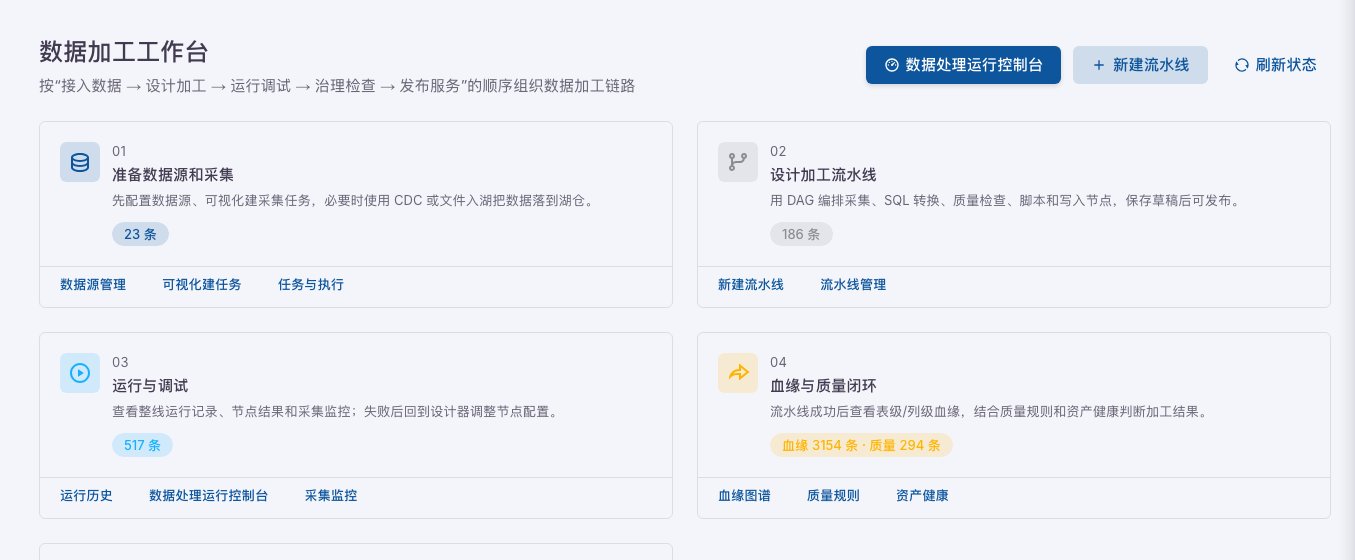
Organized as ingest → design → run and debug → governance checks → publish services.
Layered architecture
Scales from a single node to small clusters and full clusters; supports domestic operating systems (Kylin, UOS, openEuler) and databases (Dameng, Kingbase, DWS).
Within AUTOPLAT
DataHub supplies governed data and semantics: AIDA asks data on it, AIHub reads catalog contracts, AIBase uses training datasets, and Maindata links master data.
Let AI use governed results safely
Book a demo to see one dataset go from ingestion and governance to secure use by agents.